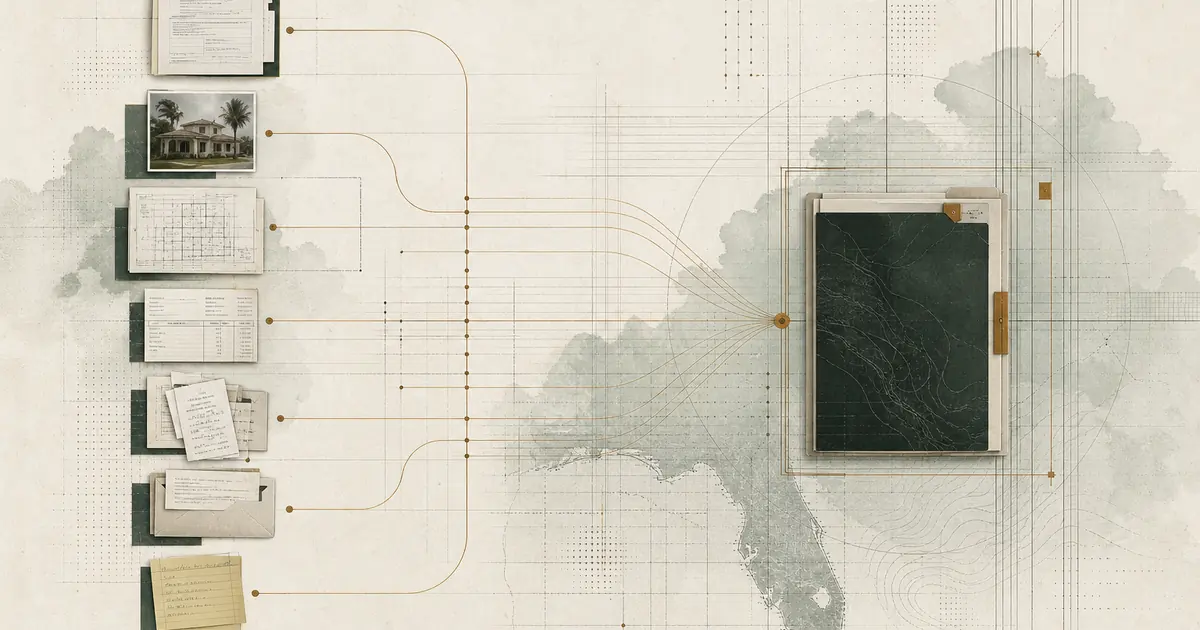
Key takeaways
- Collect documents by the decision they support, not only by file type.
- Preserve originals, metadata, source, received date, and every material version.
- Distinguish policy documents, observed facts, professional opinions, and carrier positions.
- Maintain a submission copy that cannot change after sending.
- Carry document context through payment and closeout.
1. Engagement and authority documents
- Executed public adjusting contract and addenda
- Required disclosure form
- Proof that unaltered copies were provided
- Authorized contacts and communication preferences
- License and firm information
- Cancellation or amendment records
These documents establish authority and should be complete before they are treated as routine administrative paperwork. Florida Statute § 626.8796(1)-(6) is the controlling source for the public-adjuster contract, disclosure, copy-delivery, and related residential-property requirements; confirm the current text and claim type before use.
2. Policy and claim identity
- Declarations
- Complete policy form
- Endorsements and riders
- Renewal or cancellation notices relevant to the loss
- Claim acknowledgment and claim number
- Carrier and adjuster contact information
- Mortgagee or other dual-interest information
Record whether the policy set is complete. Use the exact form and endorsement identifiers where available.
3. Loss facts and notice
- Policyholder loss statement
- Date and cause information
- First notice of loss
- Delivery or receipt confirmation
- Mitigation and emergency-service records
- Weather or event verification
- Witness or occupant statements
- Inspection scheduling records
Separate direct observations from secondhand statements and analysis.
4. Property evidence
- Original photos and video
- Photo index and annotations
- Measurements and sketches
- Moisture or testing records
- Inspection reports
- Damaged-property inventory
- Receipts or proof of ownership
- Permit and prior-repair history when relevant
Preserve original media. Edited or annotated copies should not replace it.
5. Scope and estimate documents
- Carrier estimate and revisions
- Firm estimate and revisions
- Contractor proposals
- Invoices and receipts
- Estimate comparison
- Omitted-scope list
- Product data or manufacturer instructions
- Code and permit sources selected for the issue
- Reviewer and approval record
Connect each estimate version to the evidence available when it was prepared and to the package actually submitted.
6. Communications
- Emails and letters
- Portal messages
- Call notes with participants and time
- Requests for information
- Reservation or coverage correspondence
- Payment and denial letters
- Policyholder status updates
- Delivery failures and corrected communications
Save attachments with the communication, not in an unrelated folder. Preserve what was sent rather than only the latest draft.
7. Proof-of-loss and submission packages
- Proof-of-loss form and support
- Sworn or notarized records, if applicable
- Submission cover communication
- Exact attachments and versions
- Recipient and delivery channel
- Timestamp and delivery confirmation
- Carrier acknowledgment and response
Create a read-only snapshot or export of every material package.
8. Additional living expense and contents records
- Temporary housing records
- Receipts and expense logs
- Normal-expense baseline used by the firm
- Contents inventory
- Purchase evidence
- Replacement receipts
- Carrier evaluation and payment records
- Any separate public-adjuster compensation agreement required by Florida Statute § 626.854(11)(d) for additional living expense services, where applicable, and approved procedure
Keep sensitive personal information access-controlled.
9. Payment and depreciation records
- Payment letters
- Checks or electronic payment details
- Payees and endorsement status
- Estimate version associated with payment
- Deductible treatment
- Withheld depreciation
- Repair or replacement evidence
- Depreciation recovery submission
- Fee and client disbursement record
The recoverable depreciation tracker for public adjusters provides a line-level operating model.
10. Dispute and resolution records
- Disputed issue list
- Rebuttal or supplement and sources
- Mediation or appraisal records
- Expert reports
- Counsel communications stored under the firm's privilege procedure
- Settlement authority and outcome records
- Final release or closure documentation, if applicable
Do not mix privileged legal material into a broadly accessible claim folder without an approved access model.
11. Closeout and retention
- Final payment reconciliation
- Remaining open or unavailable items
- Final client communication
- Complete claim export
- Retention category and destruction date
- Access revocation
- Vendor export confirmation
- Audit of unresolved delivery or signature issues
Retention requirements should come from current law, approved firm policy, contracts, and counsel, not a generic article.
Add context to every document
At minimum, record:
| Metadata | Why it matters |
|---|---|
| Document type | Supports filtering and review |
| Source | Shows who supplied it |
| Received or created date | Places it in the chronology |
| Effective or event date | Distinguishes content date from upload date |
| Version | Prevents overwrite and mistaken use |
| Claim issue | Explains what it supports |
| Review state | Draft, verified, approved, superseded, or submitted |
| Access class | Protects sensitive or privileged material |
File naming pattern
A stable pattern can combine date, category, short description, and version:
2026-07-08_estimate_carrier-revision_v02.pdf
Do not put sensitive personal data in filenames. The pattern should make sorting useful without replacing structured metadata.
Quality-control test
Select one submitted claim position and trace it backward. The file should reveal the exact communication, attachment set, estimate version, supporting evidence, reviewer, and delivery confirmation. Then trace one payment forward to the estimate and carrier explanation it addresses.
If either chain breaks, the document set is not yet a reliable claim record.
This guide supports document organization. It does not define every document required for a claim or establish legal, evidentiary, retention, coverage, or professional sufficiency.
Official sources
- Florida Statute 627.70131: Claim communications, estimates, and records
- Florida Statute 626.854: Public adjuster duties, restrictions, and ALE compensation agreement
- Florida Statute 626.8796: Public adjuster contracts and disclosure
- Florida DFS Consumer Assistance
- Florida DFS: What to Expect After Filing a Homeowners Claim